Michael Bracewell »Concerning the Art of Thilo Heinzmann«
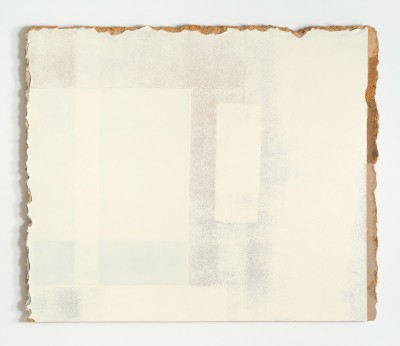
»Malerei«, 1994
The viewer’s first experience is of a chalk-white picture plane, which is almost square. This white background has a quality that is inscrutable, modern, and impassive; above all, it appears to yield up its texture to the possibility of imprint and disturbance. In this it possesses a certain tension—as though its slightly rough, matte surface is both taut and absorbent. Visually, this presents a quality that makes the picture plane neither the host nor the agent of meaning.
Rather, one might think of this dense white surface as providing one half of an aesthetic formula that resolves a tension of opposites—achieving a meticulous balance of pictorial, conceptual, and sensory qualities. For reacting upon, within, and against the flat matte white of the plane is a dramatically diffusing burst of black pigment—a supernova of exploding darkness that manifests as if literally suspended within the instant of its cataclysmic release.
The epicenter of this “explosion” of pigment appears to lie just slightly to the left of the center of the picture plane, and to be raised a few degrees toward the upper left corner of the painting. The sensory and emotional effect is immediate and visceral, engaging the viewer’s gaze in the manner of both dramatic spectacle and visual analysis. Firstly, one is aware of what might be termed “points of detonation” within the flaring shards of blackness. These are those points where the pigment is in dense, concentrate clusters, which are then separated by more gaseous-looking areas of grayness, strafed with darker blurs and spots of black, and attended within their hinterland by miniaturized reprises of the central darkness.
In terms of patterning and motion, one might liken the dynamism and seemingly arrested velocity of the burst of black pigment to an image within astronomical photography. But as one looks more closely, and allows what might be termed the “gravitational field” of the painting to exert its own rearrangements of sense and space, so a fundamental mysteriousness reasserts itself. For the visual effect of the detonation of black pigment is sensed by the viewer in a manner that is at once visual and tactile; the dichotomies between white and black, speed and stillness, diffusion and explosion, are resolved by the painting into a trans-sensory relationship between texture and form. Pictorial no less than compositional qualities—in terms of media, aesthetics, and what once was critically revered as the “integrity of the picture plane”—are transposed into a simultaneity of sensory impressions: stark, auto-generative, minimal, yet also filled with drama, emotion, and a near scientific sense of wonder.
Such could be a viewer’s first impression of a painting made by Thilo Heinzmann in 2012 (O.T. [Untitled], like the majority of his works). In the purity of its binary elements (black and white, flatness and velocity) this painting might also be seen to summarize Heinzmann’s founding interest in the balancing of figuration and abstraction—in making these two seemingly opposing qualities synonymous with one another.
The art of Thilo Heinzmann, since his earliest works from the mid-nineteen-nineties, might therefore be seen as a pioneering exploration of the nature and capacities of painting. In this, Heinzmann has made a body of work that can seen as both singular and collective, making successive developments in concept and process, the progression of which is cumulative within the sensibility of his artistic concerns.
Over nearly two decades, therefore, Heinzmann has examined in interrelating series of paintings those qualities seen as fundamental to the activity and art of painting: form, color, composition, light, surface, texture, scale. It seems as though his art makes a primary engagement with what might be termed the “primal” conditions of painting. As such, the art of Thilo Heinzmann can also be seen to engage with notions of aesthetic and conceptual fetishism—developing a visual language which makes eloquent the beguiling tension and resolution between sensory and visual phenomena.
An early work, Malerei (Painting, 1994) goes some way to establishing the terrain of Heinzmann’s enquiries. The viewer sees a landscape-format section of pressboard (or “woodchip”), the edges of which are rough, as though torn and apparently weathered—as if the pressboard had become soft and mulch-like, and then re-constituted and re-hardened. Within this ambiguous and semi-industrial picture plane, there are defined areas of flat white paint, in varying gradations of thickness. In the lower half, the lighter density of whiteness allows the darkness of the pressboard to show through. In the upper section, the whiteness is thicker and more resolved. The painted area is ranged slightly to the left, leaving a margin of raw pressboard, ragged-edged and distressed toward its lower righthand corner.
This margin appears to intensify the inscrutability and ambiguity of the white painted area. The painting seems to play with the apparent impossibility of being simultaneously resolved and left in mid-process. As such, the viewer’s experience of the painted surface and the surface texture of the rough-edged pressboard is placed into a new alignment: there is an actual dialogue between “background” and the painted surface, which in turn redetermines the aesthetic status of the painting. Smoothness and roughness become as visually codependent as “whiteness” and “rawness”—the viewer’s awareness of the act of painting, as much as the materials and processes of painting, becomes as it were anonymously heightened.
A slightly later painting, Sitzende Frau (Seated Woman, 1995, p. 8) appears to extend the conceptual and aesthetic territory opened up by Malerei. In this later work, the “background” of the portrait format of painting is a rich, vivid, and egg-yolk yellow—seemingly applied in forceful vertical strokes, and with varying densities of color. Orange and gold suffuse certain sections, and in the upper left-hand quadrant a reddish gash can be seen that is echoed in a softer, broader, and slightly elongated form toward the lower left. This is flanked by descending hemispherical sections of orange/yellow, which after the punctuation of a forceful downward vertical give way to a roughly square-like section of blue-green, on the upperpart of which sits a square of diaphanous black fabric. This same fabric is used to create the central “pictorial” element: two horizontals and a vertical above them, on the right-hand side. The right-hand edge of the picture plane is indented, leaving a strip of whiteness.
Sitzende Frau becomes more complex, visually, as the viewer attempts to find a point from which to take their bearings. The relationship between the forceful, flame-like color and the “cut-out” elements of semitranslucent black fabric tends to sharpen the viewer’s visual sense, alerting a sensory “second-sight” to the experience of the painting. Heinzmann’s concern, conceptually and aesthetically, appears to be with the capacities of aesthetic sensation that derive from the “stuff” of the painting process. The roles of texture and gesture become fetish-like—engaging with an eroticism that derives from the coupling and abutting of materials, their “erogenous zone” located within the grain and consistency of the edges and meetings of materials, and their heightened and exposed rawness.
Once again, these concerns and qualities appear to be cumulatively developed by Heinzmann in the subsequent progression of his art. Having established a deeply felt concern with texture and pictorial presence—and the relationship between figuration and abstraction as repositioned through the dialogue between materials, composition, and aesthetic sensation— Heinzmann then refines these questioning statements into a more concentrated form.
A series of works made in the year 2000 in the media of pigment and epoxy resin on styrofoam, each framed behind a plexiglass cover, can be seen to both consolidate and advance the progress of Heinzmann’s art to date. In black, red, and a cool, peppermint green (for example) these paintings—their materiality, effect, and presence both protected and amplified by the box-like plexiglass cover—sharpen the interactions between their media. It is almost as if the resin were bleeding and pooling from elongated vertical and horizontal lacerations, or acid cuts, within and across the picture plane. This produces an effect that might be likened to classic abstraction (echoes of the art of Paul Klee); and yet the foregrounding of texture, process, and substance, enabling self-generative effusions and reactions of effect, imbues the paintings with an immaculate balance of delicacy and volatility. Their presence is at once elemental and chemical, raw and committed to visual and sensory fetishism.
The art of Thilo Heinzmann enables an empowering confluence of ideas and art-making processes. At their center would seem to be the paradoxical fusion of aesthetic density (in terms of texture, color, and materials) and a form of covert Minimalism—covert inasmuch as the reduction and refinement of the artistic process, to recognizably minimalist pronouncement, is held in aesthetic reserve to such qualities as primal gesture, tactility, and the conflation of opposing qualities. Heinzmann’s relationship to Minimalism, therefore, can be seen as more of a consequence of his art-making processes and conceptualism, rather than their point of departure or intention. The minimalism of process serves to heighten Heinzmann’s celebratory and at times irreverent engagement with painting.
There is without doubt a conceptual and aesthetic playfulness to Heinzmann’s art, in which the act of painting can take a variety of increasingly audacious media and processes. His interest with material is extended to include animal hide, mosaic, plaster, gum, peacock feathers, mineral, fur, wood, tin, hessian, cotton wool, and crystal—a bewitching lexicon of media that might, on the one hand, be said to denote archetypical qualities (a periodic table of symbolism) but yet which are deployed by Heinzmann in juxtapositions, patterns, and constellations that appear simultaneously random (consequent on a single gesture) and highly refined.
In his Pigment Paintings the diffusion of pigment lends a poetical and richly atmospheric air—an intimation of weightlessness and drift that is matched by the pictorial declaration of parity between material texture and composition. Nuggets and fragments of white cotton wool on a white background (from a series made in 2011–12) may well indicate a near Zen-like approach to process, to both Minimalism and the classically Surrealist fascination with the eroticism and fetish-like nature of texture and surface.
The art of Thilo Heinzmann is empowered by its constant evasion of set aesthetic criteria. In this, the “primal” nature of the work reasserts itself, rather as though Heinzmann’s sensibility as an artist were closer to that of pre-Christian and “tribal” art-making, in which the exploration of a form and medium is devoted to achieving direct forms of expression, unconcerned with canonical values.
This is a position consolidated by Heinzmann’s recent Tacmo series of paintings, in which the pristine black surface of the picture plane—at once seemingly taut and yielding—is disturbed by a sequence of deft gestures that leave a “gloss” trail or imprint: black on black. These paintings likewise evade assimilation into a reductively art-historical appreciation of the “black painting”; rather, they possess a tension of opposing qualities (stillness and movement, surface and gesture) that enhance their negotiation of form, and their determined correlation of sense and sensation.
As such, Heinzmann’s art can be seen as fixated on simultaneity: on the synchronized enshrinement and deconstruction of painting itself, its materials, grammar, and language. Enmeshed within this simultaneity is a primal joyousness, denying philosophical pessimism and asserting a sensory and intellectual immersion in the possibilities of painting as an act. In this, the art of Thilo Heinzmann is filled with restless enquiry as much as meditational stillness—catching process and transfiguration in their moments of realization, at once immediate and suspended in time.
in: Thilo Heinzmann, Hatje Cantz, 2012, pp. 16-19